



Professional content for healthcare professionals
ALGYL COLL · medical device profile

Structural support and extracellular-matrix regeneration.

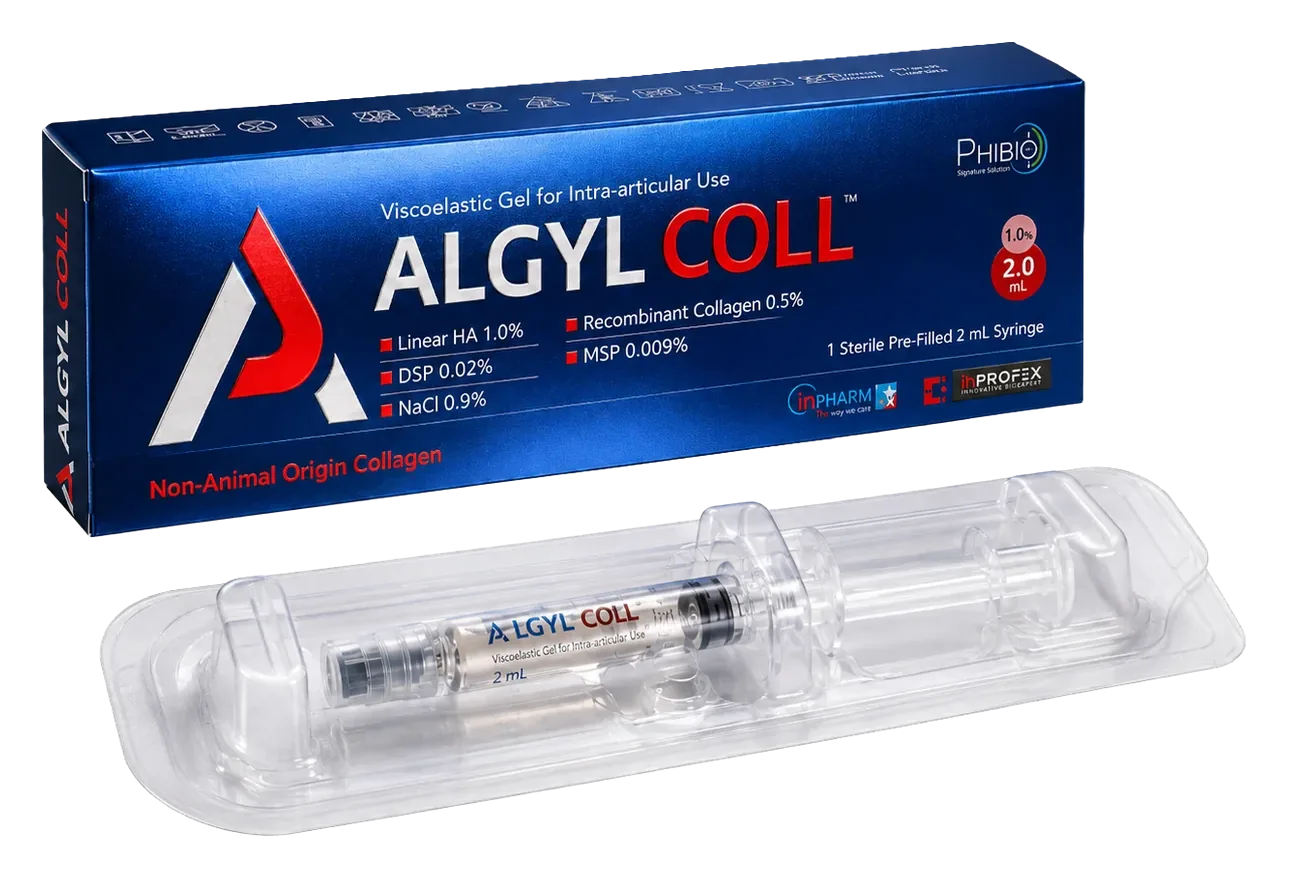
Combination of linear HA 1.0% and recombinant human collagen 0.5% of non-animal origin in a single sterile 2 mL pre-filled syringe. A rational therapeutic concept matching the multifactorial view of osteoarthritis.

ALGYL COLL
1.0 %linear hyaluronic acid
0.5 %recombinant collagen (non-animal)
2 mlsterile pre-filled syringe
III · CEclass III medical device
Introduction

Osteoarthritis as a complex pathological process.

Osteoarthritis (OA) is the most common chronic joint disease. Its core pathology involves a decrease in HA content in synovial fluid and catabolic dominance in cartilage. The result is insufficient collagen and HA renewal, loss of elasticity, and cartilage thinning.

Characteristics and composition PER IFU

A formulation based on linear hyaluronic acid and recombinant collagen.

The active constituents of ALGYL COLL are hyaluronic acid and recombinant collagen. The product further contains a buffering component (DSP/MSP) that maintains a stable pH, and saline. The product is supplied in a syringe ready for direct use.

Linear HA

1.0 %

Tissue lubricant and viscoelastic support — it keeps the internal surfaces of the joint apart, cushions impact, lubricates and has a modulating effect on nociceptors.

Recombinant collagen

0.5 % · non-animal

A biotechnologically manufactured protein of non-animal origin. It has an amino acid sequence identical to human collagen (ALGYL COLL product profile).

DSP

0.02 %

A buffering component maintaining a stable physiological pH of the product.

MSP

0.009 %

A complementary buffering component for the stability and tolerability of the gel.

Carrier: NaCl 0.9% (isotonic) Volume: 2 mL pre-filled syringe Needle: 18–22G × ½ Collagen: non-animal origin Classification: Class III MD · CE 2764 Sterilisation: autoclave · 2-year shelf life
Mechanisms of action

Two complementary pillars — HA and recombinant collagen.

Both components act on different, yet complementary aspects of the pathophysiology of osteoarthritis: hyaluronic acid restores the properties of the synovial fluid and the joint microenvironment, while recombinant collagen provides the structural protein component for the extracellular matrix.

Hyaluronic acid
Scientific literature

Viscosupplementation with biological effects.

The HA contained in the product is of the linear type and acts as a tissue lubricant with a significant role in regulating the interactions between adjacent tissues in the joint. A 2025 meta-analysis describes it as a versatile osteoarthritis therapy whose benefit rests on a combination of mechanical and biological mechanisms.

  • ViscosupplementationRestores the viscoelastic properties of the synovial fluid and keeps the internal joint surfaces separated.
  • ChondroprotectionCreates a hydrated microenvironment favourable to chondrocyte survival and nutrient diffusion.
  • Analgesic effectActs on nociceptors; the meta-analysis describes a reduction in pain and an improvement in function in patients with gonarthrosis.
  • Anti-inflammatory effectReduces friction and mechanical overload of the cartilage, thereby limiting further degradation of the collagen network.
Linear HA 1.0 %Tissue lubricantPersonalised OA treatment
Recombinant collagen
Scientific literature

A standardised protein produced by biotechnology.

Recombinant human collagen is a protein produced using genetic engineering technology, whose structure and function correspond to those of natural human collagen. According to an extensive 2025 review, it ranks among the most important biomaterials of regenerative medicine.

  • Human sequenceThe amino acid sequence exactly replicates the sequence of natural human collagen.
  • Structural supportProvides mechanical support to the matrix and activates the cellular receptors regulating its synthesis.
  • Non-animal originThe safety risks associated with collagen extracted from animal tissues are eliminated.
  • Standardised manufacturingHigh purity and precise molecular design allow the resulting material to be controlled.
Recombinant collagen 0.5 %High purityRegenerative medicine
Rational combination

Combination of recombinant collagen with hyaluronic acid.

The combination of the two components is based on their complementary biological and biomechanical properties. Hyaluronic acid contributes to the viscoelastic properties of the intra-articular environment, while recombinant collagen represents the structural protein component. The combination of these components therefore represents a biologically rational approach targeting different aspects of the joint environment.

1

HA — hydration and lubrication

Hyaluronic acid

HA creates a hydrated environment supporting chondrocyte survival and nutrient diffusion. It reduces friction and mechanical overload of the cartilage.

+
2

Collagen — mechanical support

Recombinant collagen

Collagen provides mechanical support and at the same time activates the cellular receptors regulating the synthesis of the extracellular matrix.

=
3

Symptomatic and structural effect

Rational combination

The combination acts both symptomatically (pain relief, improved function) and potentially structurally (support for matrix repair).

A rational approach targeting the biomechanical and biological component of osteoarthritis at the same time.
Area of use / indications

Treatment of the painful symptoms of joint diseases.

The product is intended for the treatment of the painful symptoms of joint diseases such as osteoarthritis and inflammatory tendon disorders. It is further indicated for the viscoelastic supplementation or replacement of synovial fluid in joints (hip, knee, elbow, ankle) and tendons.

OsteoarthritisHip · kneeElbow · ankleInflammatory tendon disorders
Practical instructions
Intra-articularly

Viscoelastic supplementation or replacement of synovial fluid in the joints.

  • The injection is performed by an orthopaedic surgeon/trained physician under aseptic conditions.
  • Needle 18–22G × ½, administer only into the synovial space.
  • Frequency at the physician’s discretion (e.g. 6 / 8 / 12 months).
  • In the case of effusion, aspiration, rest, ice and possibly cortisone are recommended; COLL is administered 2–3 days later.
Contraindications, warnings: Hypersensitivity to the components of the product, skin or joint infection at the injection site, systemic bleeding disorders, a history of allergy to proteins of gram-positive bacteria. It is not used in pregnant and breastfeeding women or in children. Patients on chemotherapy must be assessed by an orthopaedic surgeon. For adverse effects see the IFU. Do not use together with disinfectants containing quaternary ammonium salts. The device is for single use only.
Sequential protocol

Complementary use with other products.

Optimal treatment of osteoarthritis and painful disorders of the musculoskeletal system (post-traumatic conditions, the period following arthroscopic procedures) may benefit from a sequential combination of viscosupplementation, support for cartilage regeneration and structural remodelling.

A concept of sequential use — based on the complementarity of the individual products and on the available preclinical/professional sources, not on a clinical study of the entire two-step sequence.

Indicative interval between the main steps: 2–3 weeks
Step 1

ALGYL GGP

Preparation and activation

HA · N-acetylglucosamine · glycine · proline

Optimization of the intra-articular environment (HA viscosupplementation), activation of cartilage metabolism (NAG), and support for proteoglycan synthesis and matrix regeneration (glycine, proline).

Step 2

ALGYL COLL

Structural support

Linear HA · recombinant collagen

Continued viscosupplementation; recombinant human collagen contributes to extracellular-matrix regeneration, supports chondrocyte adhesion and activity, type-II collagen synthesis and long-term remodeling.

Concurrently, per clinical findings — optional add-on

ALGYL CBD

Local support for pain

Non-invasive option for pain, after trauma or arthroscopy — CBD, arnica, menthol.

PRP

Optional biological augmentation

Optional for practices that routinely use PRP. Published studies describe synergy of growth factors with HA.

Note: The scheme is a proposed combined approach, not a universal treatment algorithm. Product choice, order and intervals depend on current documentation, clinical findings and physician decision.

For healthcare professionals

Would you like ALGYL COLL in your practice?

Contact the Sales Management or the Medical Representative for your region directly — with complete documentation and a tailored offer.

View contacts →